LOCAL LEAGUE RULES
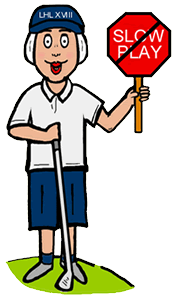
Our league follows all USGA rules. In order to maintain a steady pace of play, we have also added the following:
The first tee time is 5:30 p.m. No golfers will tee off until our first tee time.
Pick ball up after 10 strokes. These 10 strokes include any penalty strokes you may have received.
If you hit two balls into the same water hazard, you should pick up your ball and drop it on the opposite side of the hazard and continue your play. You must count both penalty strokes for the ball entering the water hazard.
Put first and last names on the score card you turn in. We’ll have a collection folder for scorecards in the golf league organization notebook in the clubhouse.
Back to Top
-----------------------
GOLF ETIQUETTE
For the seasoned players, this is a reminder. For those of us who are new to the wonderful game of golf, the following are basic guidelines that every golfer should try to abide by.
Get accustomed to playing "ready golf". This means that players tee off when they are ready, not necessarily in the order of "honors" from the last hole.
If you find your group lagging behind and there are other league members held up by your group’s pace of play (i.e., if you notice there’s a hole between your group and the leading group), please signal the group behind to play through.
Be quiet when other players are preparing to take a stroke.
Make sure you hit your own ball. Know your ball’s make and number and be able to identify it before hitting it.
Replace your divots.
After hitting out of the bunker, rake the sand neatly, smoothing all ball marks and footprints.
Repair ball marks on the green.
No bags or carts (electric or pull) on the green. Pull your bag to the side of green closest to the next hole. NEVER leave our bag or cart in front of the green.
Know where each player’s line of putt is. This is the path the ball is likely to take to the cup. Avoid stepping on this line.
The player whose ball is closest to the cup minds the pin (flag stick).
Be ready to putt when it’s your turn. Use the time the other players are putting to line up your putt.
In every instance the player whose ball is farthest from the hole is the first to hit, unless there is a delay (i.e., looking for the ball, retrieving a club). Other players may hit out of turn in order to speed the play if there is a delay.
The player furthest away from the pin may putt first. When all balls are on the green, each player shall putt continuously, if desired, until the ball is holed, unless by doing so a player would stand in another golfer’s line of play. Stepping on the edge of the cup is careless and inconsiderate.
Leave the green promptly after putting out so the next group can hit on. Record scores on scorecard at next tee!
Remember golf is a game. Have fun!
Accept the fact that bad shots and bad rounds are inevitable.
Back to Top
-----------------------
USGA RULES SUMMARY
TEEING GROUND
Ball must be played from within the teeing ground. Golfer may stand outside the teeing ground to play a ball that’s inside the teeing ground.
Back to Top
-----------------------
PLAYING THE BALL AS IT LIES
You are not allowed to improve:
- The position or lie of your ball;
- The area where you will be swinging;
- Your line of play;
- The extension of that line beyond the ball; or
- The area where you’re going to drop or place the ball.
Back to Top
-----------------------
BALLS LYING IN OR TOUCHING A HAZARD
Before you take a stroke at a ball in or touching a bunker or a water hazard, you are not allowed to:
- Test the condition or the hazard or one like it;
- Touch the ground or the water in the hazard with your hands or clubs or anything else unless you fall or nearly fall while legally removing an obstruction, measuring, or retrieving or lifting a ball;
- Handle any loose impediment in or touching the hazard.
Back to Top
-----------------------
PLAYING A MOVING BALL
In general, you’re are not permitted to play your ball while it is moving. Exceptions and special conditions are:
- When the ball falls off the tee in the middle of your swing
- Ball in moving water. Should you decide to hit a moving ball out of a water hazard, there is no penalty. You are not, however, allowed to wait and watch in hopes the wind or current will place your ball in a better position.
Back to Top
-----------------------
PLAYING A WRONG BALL
There is a two-stroke penalty for playing the wrong ball. If you should play the wrong ball, return to your ball and continue play after accessing the penalty, unless the play had finished on that hole.
Back to Top
-----------------------
THE PUTTING GREEN
Do no touch the line of putt! On the putting green, you may do the following:
- Move sand, loose soil, and other loose impediments. Pick them up or brush them aside with your hand or club without pressing down.
- When addressing the ball, it’s okay to place the club in front of the ball, just don’t press anything down.
- You may touch the line of putt while measuring, lifting the ball, pressing down a ball marker, repairing old hole plugs or ball marks on the putting green or removing movable obstructions.
Don’t make a stoke on the putting green while straddling the line of putt, or with either foot touching the line or the line’s extension beyond the ball.
Don’t play a stroke while another ball is in motion after a stroke on the green.
If your ball is hanging over the edge of the hole, USGA Rules allow you time to get there and then ten more seconds to wait and see if it will roll in. If it doesn’t fall in until after ten seconds, tap it into the hole and add the stroke to your score. If it falls in, but after the ten seconds, add a stroke to your score and proceed to the next hole.
Back to Top
-----------------------
HOLING OUT
You must hole out on every hole. Your ball must enter each and every hole on every putting green.
Back to Top
-----------------------
LIFTING, DROPPING, AND PLACING
DROPPING THE BALL
You must drop your own ball. Stand straight, hold the ball at shoulder height, and release it. If the ball touches you or your equipment before or after it lands, there’s no penalty, but you must drop it again. There’s no limit to how many times you may re-drop it for this reason. You must drop your ball as close as you can to the spot where it was. Do not move it nearer to the hole.
You must re-drop your ball if it rolls:
- Out of a hazard;
- Onto a putting green;
- Out of bounds; or
- Back into the situation that caused you to take relief
You must re-drop your ball if it comes to rest:
- More than two club-lengths from where it first struck after the drop, or
- Nearer the hole than it was originally
Back to Top
-----------------------
CLEANING THE BALL
You may lift and clean your ball on the putting green. Other than the putting green, you may clean your ball when it is legally lifted. Cleaning your ball in any other situation will result in a one-stroke penalty.
Back to Top
-----------------------
OBSTRUCTIONS
MOVEABLE OBSTRUCTIONS (I.E. HOSES, CART DIRECTION ARROWS)
If the ball doesn’t lie in or on the obstruction, move the obstruction. If the ball moves as a result of you moving the obstruction, replace the ball. There is no penalty stroke.
If the ball is in or on the obstruction, lift the ball and move the obstruction. Then, drop the ball.
Always put the ball as close as possible to a point directly under where it was lying in or on the obstruction. Don’t place it nearer to the hole than it was.
Back to Top
-----------------------
IMMOVABLE OBSTRUCTIONS (SHELTER HOUSES, BENCHES, TRASH CANS)
INTERFERENCE
An immovable obstruction is "interfering" when the ball lies in or on the obstruction. It’s also interference when the ball lies so close to the obstruction that it disrupts the player’s stance or the area intended swing.
RELIEF
Except when the ball lies in or touches a water hazard or lateral water hazard, you may obtain relieve from an immovable object as follows:
- Determine a point that is the nearest point to the ball’s lie, does not bring the ball nearer to the hole, avoids the interference, and is not in hazard or on a putting green. In determining this point, you may not cross over, through, or under the obstruction.
- Lift and drop the ball within one club length of this point. Note that you may cross over, through, or under the obstruction if the ball lies in or under it, or if the obstruction is the artificial surface of a road or a path.
If there’s reasonable evidence that a ball is lost in an immovable obstruction, there’s no penalty for substituting another ball.
Back to Top
-----------------------
ABNORMAL GROUND CONDITIONS/WRONG PUTTING GREEN
Interference occurs anytime your ball lies in or touches casual water, ground under repair, or a hole, cast, or runway of an animal. If your ball’s on the putting green, any of these conditions in the line of your putt is interference. You may either play the ball as it lies, or take relief.
Back to Top
-----------------------
ON THE PUTTING GREEN
If your ball lies on the putting green, with some type of abnormal ground condition between it and the hole, you may lift your ball and place it in the nearest position to the ball’s original position that gives the most relief from the abnormal ground condition, but not closer to the hole.
Back to Top
-----------------------
THROUGH THE GREEN
If our ball comes to rest in an abnormal ground condition, you may seek relief by dropping the ball within one club-length of a spot outside of the condition. This spot must avoid the interference and must not be closer to the hole or in a hazard or on a putting green.
You may also seek relief if your ball comes to rest so close to an abnormal ground condition that you would be forced to stand in it in order to play your ball.
Back to Top
-----------------------
WITHIN A BUNKER
In a bunker, if there’s interference by an abnormal ground condition, you may:
- Without penalty, lift and drop the ball as close as possible to where it was, on ground that gives you the best relief but doesn’t bring your ball nearer to the hole;
- With a one-stroke penalty, drop your ball outside the bunker. Make sure to keep the spot where your ball was lying directly between the hole and the spot where you drop it.
Back to Top
-----------------------
EMBEDDED BALL
A ball embedded in its own pitch-mark in any closely mown area may be lifted, cleaned, and dropped without penalty.
Back to Top
-----------------------
BALLS ON THE WRONG PUTTING GREEN
Determine a point closest to where the ball lies that doesn't move the ball nearer to the hole and is not in a hazard or on a putting green. Lift and drop your ball within one club-length of this point. There is no penalty for this drop.
Back to Top
-----------------------
WATER HAZARDS
You may drop the ball behind the water hazard, making sure the point where the original ball crossed the edge of the water hazard is directly between the hole and the spot where you drop the new ball. There's no limit to how far back from the hazard you may drop the ball.
You may drop the ball as near as possible to the spot where the original ball was played. If the stroke was played from the teeing ground, you may tee the ball anywhere within the teeing ground.
Back to Top
-----------------------
LATERAL WATER HAZARDS
You may drop the ball behind the water hazard, making sure the point where the original ball crossed the edge of the water is directly between the hole and the spot where you drop the ball. There's no limit to how far back from the creek you may drop the ball.
You may drop the ball as near as possible to the spot where the original ball was played. If the stroke was played from the teeing ground, you may tee the ball anywhere within the teeing ground.
You may drop the ball outside the water hazard, within two club-lengths of the point where the ball crossed the edge of the hazard, or point on the opposite edge of the hazard equidistant from the hole. The ball must be dropped and come to rest no nearer the hole than the point where the ball crossed the edge of the hazard.
Back to Top
-----------------------
BALLS THAT ARE LOST, OUT OF BOUNDS OR UNPLAYABLE
OUT OF BOUNDS
If your ball goes out of bounds, you must play another ball from as near as possible to the spot where the original ball was played. Count both strokes and add a penalty stroke to the score for the hole.
Back to Top
-----------------------
LOST BALL
If you can't find your ball, you must play another ball from as near as possible to the spot where the original ball was played. Count both strokes and add a penalty stroke to the score for the hole.
Back to Top
-----------------------
PROVISIONAL BALL
If it's possible that a ball just played may be lost outside a water hazard or may have gone out of bounds, you're allowed to play a provisional ball. You must play it as nearly as possible from the spot where you played the original ball. Please inform others you are golfing with that you intend to play a provisional ball.
If the original ball is lost outside a water hazard or is out of bounds, the provisional ball becomes the ball in play, with a one-stroke penalty.
However, if your first ball isn't lost, in a water hazard or out of bounds, then abandon the provisional ball, inform your fellow golfers and continue with the original one. No penalty strokes are accessed.
Back to Top
-----------------------
UNPLAYABLE BALL
Should your ball be unplayable (i.e., under a bush, next to a tree), you may add a one-stroke penalty to your score and seek relief in one of the following ways.
- play the ball as nearly as possible to the spot from which the original ball was last played
- drop a ball within two club lengths of the spot where the ball lay, but not nearer to the hole
- drop the ball behind the point where the ball lay, keeping the point directly between the hole and the spot on which the ball is dropped, with no limit to how far behind that point the ball may be dropped.
Back to Top
-----------------------
|